
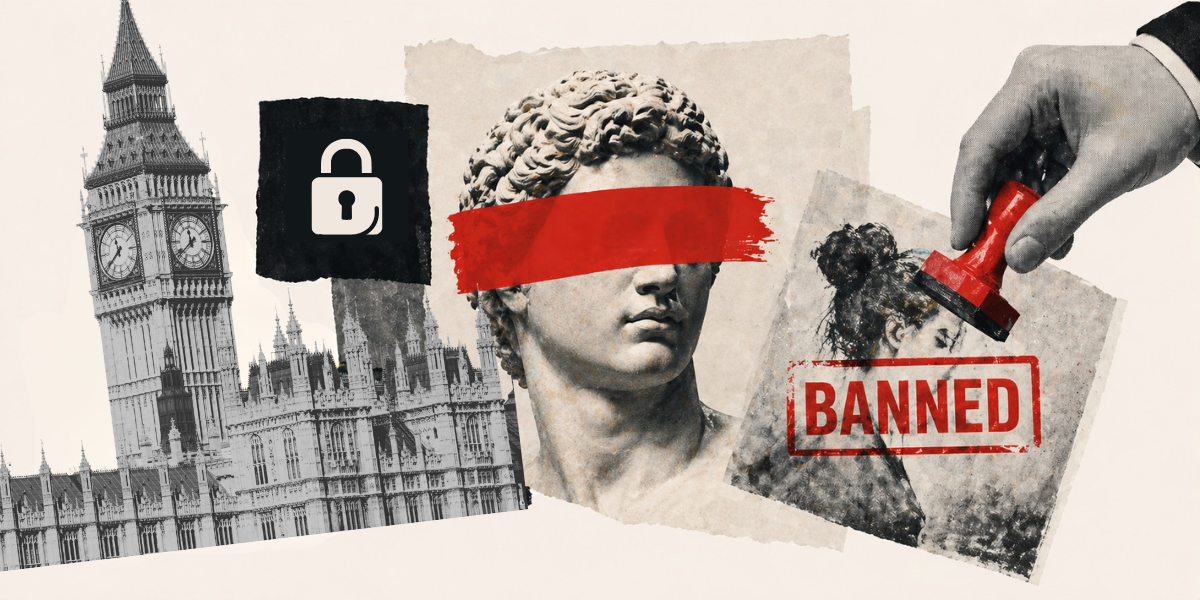
Recent proposals in the United Kingdom to criminalize certain forms of pornography illustrate a growing policy problem: the increasing willingness of governments to treat fictional depictions of sex as though they were evidence of real harm. Two examples currently under discussion in the UK make this shift especially clear.
First, the government has proposed banning pornography that depicts strangulation or “breath play”, even when the content involves consenting adult performers acting out a scenario. Second, lawmakers have announced plans to criminalize pornography depicting incest or simulated family relationships, including so-called “step-family” narratives that have become common in online adult entertainment.
In both cases, the proposed offense is not exploitation of a real person. Rather, the crime would be the fictional narrative being portrayed. For policymakers concerned with protecting victims, this distinction matters enormously.
As the Center for Online Safety and Liberty (COSL) has emphasized through its Drawing the Line initiative, effective policy depends on maintaining a clear boundary between content that documents real abuse and content that merely depicts fictional scenarios. When that boundary collapses, both civil liberties and victim protection suffer.
The UK’s Expanding Pornography Restrictions
The UK’s proposed ban on depictions of strangulation in pornography emerged from a broader government review of online pornography and violence against women. The proposal would criminalize the possession, distribution, or publication of pornographic material that shows acts of choking or suffocation during sex. Supporters argue that such portrayals may normalize violence or unsafe sexual practices.
These concerns deserve to be taken seriously. Sexual practices that involve choking or breath restriction can carry real physical risks, particularly when attempted without knowledge or communication between partners. But criminalizing fictional depictions is an unusually blunt policy response. Many activities depicted in entertainment—from extreme sports to drug use to risky sexual behaviour—can be dangerous if imitated without context. Public health approaches typically focus on education, harm reduction, and consent rather than criminalizing depictions themselves. The existence of risk does not automatically justify criminal law regulating fictional portrayals of adult behaviour.
Shortly after the breath play announcement, the UK government also announced plans to criminalize pornographic depictions of incest, including scenarios in which adult performers pretend to be relatives. Government amendments to the Crime and Policing Bill would prohibit publishing or possessing pornographic material depicting sexual activity between people presented as relatives—even when the performers are unrelated adults and the scenario is fictional.
The justification offered for this proposal is notably different from the argument used to support the strangulation ban. In the case of breath-play depictions, supporters claim that the content may encourage dangerous behaviour or normalize violence. By contrast, the proposed prohibition on incest-themed pornography appears to rest primarily on moral objection to the underlying scenario itself. The concern raised by policymakers is not that the depicted activity is physically dangerous, but that the narrative portrays a taboo relationship.
Notably, the proposal also creates an unusual situation in which fictional depictions may be criminalized even though some forms of real incest between consenting adults are not illegal in the UK, particularly relationships between adult relatives who are not prohibited degrees of kinship under the Sexual Offences Act 2003. In other words, a fictional portrayal of a taboo relationship could become illegal even where the real-world relationship itself might not be.
Together, these two criminalization proposals represent a significant expansion of criminal law into the regulation of sexual fantasy and fictional storytelling.
The Distinction That Protects Victims
When policymakers discuss sexual exploitation online, it is essential to distinguish between real harm and fictional depiction. Child sexual abuse material (CSAM), for example, documents real crimes against real victims. Every image or video represents a child who was abused during its creation. Because of this, the production, distribution, and possession of CSAM is rightly criminalized worldwide.
Fictional depictions are categorically different. Drawings, stories, animations, or scripted pornography involving consenting adults do not document abuse. This distinction is not merely philosophical. It is foundational to effective law enforcement.
COSL’s Drawing the Line initiative was created precisely to address the increasing confusion between these categories—particularly in debates about fictional or AI-generated imagery. When policymakers conflate fictional depictions with real abuse material, they risk distorting crime statistics, misallocating investigative resources, and undermining public understanding of actual victimization.
Does Fictional Pornography Cause Harm?
Supporters of stricter pornography laws often argue that depictions of taboo or violent scenarios may encourage real-world abuse. This is an important empirical question. However, decades of research on pornography and sexual violence have produced mixed and contested results. Some studies suggest correlations between certain forms of violent pornography and aggressive attitudes, while others find no clear causal relationship between pornography consumption and sexual offending.
What is clear is that criminal law traditionally requires a much higher evidentiary threshold before restricting speech or expression. The mere possibility that fictional depictions might influence behaviour has rarely been sufficient to justify criminalization. If it were, the same reasoning could apply to violent films, crime dramas, or other fictional media that depict harmful conduct.
Policymakers should therefore be cautious about using criminal law to regulate speculative harms rather than demonstrable ones.
When Moral Panic Drives Policy
Historically, expansions of pornography regulation have often followed periods of moral panic. The UK’s Online Safety Act has already sparked international debate over its implications for privacy, age verification, and free expression.
Under the Act, platforms must implement age-verification systems and remove categories of content deemed harmful to children. Failure to comply can result in substantial fines or service blocking. While protecting minors online is an important objective, critics argue that such measures risk creating a censorship regime that goes far beyond the prevention of genuine abuse.
The current proposals to criminalize breath-play pornography and incest-themed narratives illustrate how quickly such frameworks can expand, and raise an open question about what other sexual fetish practices might be next to be criminalized. In Australia, an author was convicted of a crime over her fetish novel about a couple engaging in age-based roleplay.
These developments also raise a practical question: once the state begins criminalizing sexual depictions based on perceived risk or moral discomfort, where does the boundary lie? Many consensual practices common within adult relationships—such as spanking, bondage, or dominance-and-submission roleplay—could potentially be framed as depicting harm. Without a clear limiting principle tied to actual victimization, the scope of criminalization can expand unpredictably.
Fiction, Taboo, and the Limits of Criminal Law
Throughout history, art and storytelling have explored taboo subjects. Classic literature contains themes of incest, violence, and exploitation. Modern television series such as Game of Thrones and Euphoria depict controversial relationships and sexual conduct involving fictional characters.
The question for policymakers is therefore not whether fictional depictions of taboo behavior exist—they always have. The question is whether criminal law should regulate those depictions. Traditionally, democratic legal systems have drawn the line at actual harm. Criminal law targets exploitation, coercion, trafficking, and abuse—not fictional narratives that depict troubling scenarios.
When governments begin prosecuting depictions rather than harms, the legal system moves into the territory of enforcing moral norms rather than preventing victimization. This is particularly pernicious when moral policing is extended to alternative sex and gender expressions that are prevalent within already-marginalized communities, such as U.S. state laws targeting drag shows.
It is also worth noting that many communities that practice forms of consensual kink—including activities such as bondage or breath-play—have developed extensive norms around communication, consent, and safety. These practices are often discussed openly within those communities precisely to reduce harm. Treating all depictions of such activities as inherently abusive risks obscuring the distinction between consensual adult practices and genuine violence.
The Risk of Misallocating Enforcement Resources
Equating fictional depictions with real abuse also carries practical consequences. Investigating crimes involving sexual exploitation—particularly crimes involving children—requires substantial law-enforcement resources. Identifying victims, analyzing digital evidence, and dismantling abuse networks is already an immense challenge.
If those same resources are diverted to investigating fictional pornography or scripted narratives involving adult performers, the result may be less attention devoted to real victims; in fact, that’s exactly what COSL’s Drawing the Line Watchlist 2025 demonstrates has happened.
The problem becomes even more serious when fictional depictions are included in crime statistics. Inflated numbers can distort public understanding of the scale and nature of abuse, potentially leading to policies that prioritize symbolic enforcement over effective intervention.
A Better Approach
Protecting people from exploitation requires policies that focus squarely on real harm. Effective responses include:
- identifying victims depicted in CSAM
- dismantling trafficking networks
- supporting survivors of abuse
- enforcing consent and labor protections in adult entertainment
- improving international cooperation among law enforcement agencies
These measures directly address exploitation and victimization.
By contrast, criminalizing fictional sexual narratives—whether breath-play scenarios or incest role-play—does little to protect victims. Instead, it expands criminal law into areas traditionally governed by classification systems, platform moderation, or cultural norms.
Drawing the Line
The growing debate over fictional sexual depictions highlights a larger challenge for policymakers navigating the digital age. Technologies such as generative AI, digital animation, and immersive media will only make it easier to create realistic fictional content. Governments will face increasing pressure to regulate these materials.
But the fundamental principle must remain clear:
If a depiction involves a real victim, it should be treated as evidence of a crime.
If no one was harmed in its creation, policymakers should think carefully before invoking the power of criminal law.
The United Kingdom’s current proposals to ban breath-play pornography and incest-simulation narratives illustrate how easily the boundary between fictional depiction and real harm can erode once governments begin legislating sexual expression. Protecting victims requires clarity about where real harm occurs. When the law treats fictional narratives as though they were equivalent to real abuse, it risks undermining both civil liberties and the very victim-protection goals it claims to advance.