
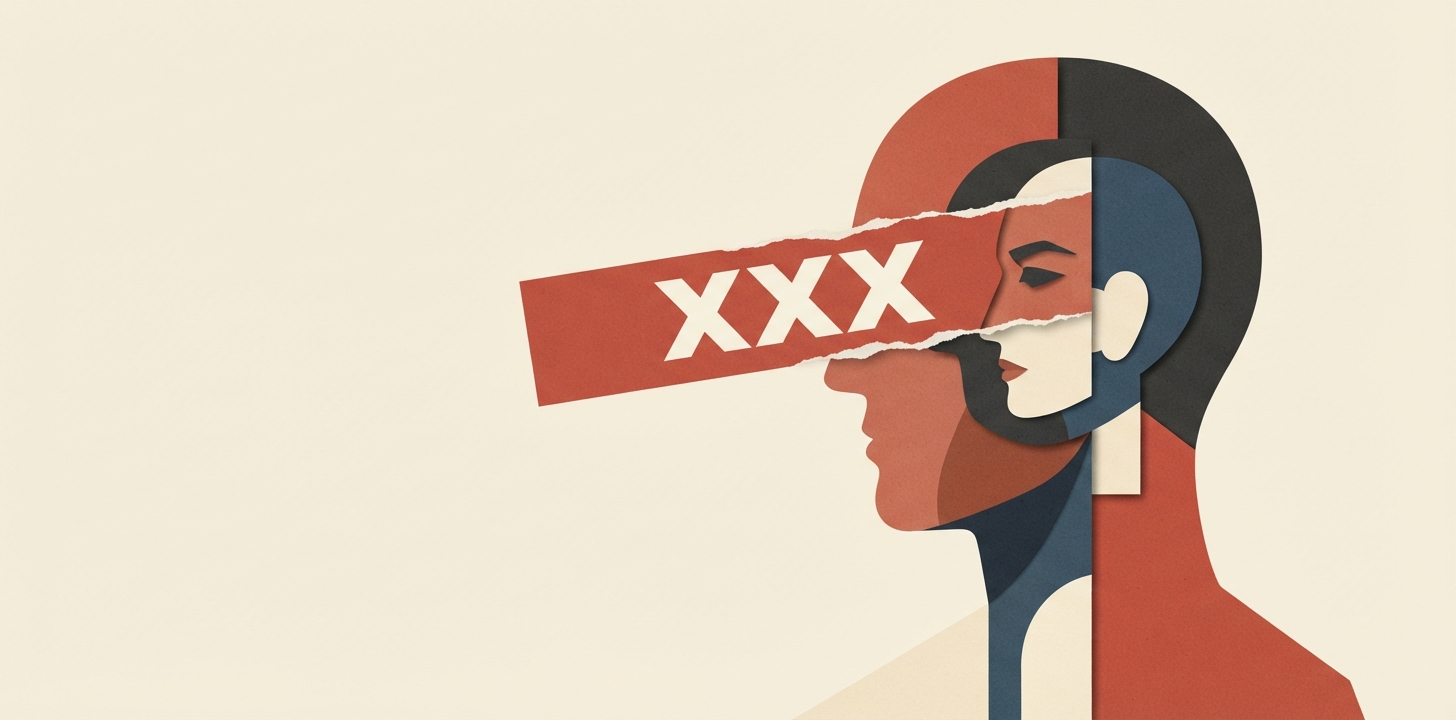
Mick Moran, chief executive of the Irish Internet Hotline and a board member of INHOPE, the international association of internet reporting hotlines, argued recently in the Irish Examiner that “‘ordinary’ porn is now a gateway to child sex abuse material”. Recommendation systems, he writes, feed an appetite for novelty and taboo until some viewers cross from adult pornography into recordings of children being abused.
What Moran wants restricted is pornography that sexualises children, and the algorithms he believes drive viewers towards it. He stops well short of calling for a general ban. But once the argument is on the table, it is hard to see where it stops. If pornography that is otherwise lawful can be prohibited because some of its viewers might later go looking for abuse material, then neither the consent of the performers nor the absence of any abuse in its making is enough to protect it.
The United Kingdom has already run with that logic. Alongside measures aimed at depictions of strangulation, commonly called choking, the government announced in April that it would restrict incest-themed pornography and ageplay, meaning adults role-playing as children. The announced penalties run to five years in prison for publication and three for possession.
Measures like these are sold as protection for women and children. But among the first people to feel their weight are women who write erotic fiction and queer filmmakers, whose work is already being criminalised or quietly withdrawn. Their experience shows how easily child protection policy turns into the regulation of sexual expression between adults.
Women’s work treated as abuse
In March 2025, Australian police charged the erotic fiction author Lauren Mastrosa over her novel Daddy’s Little Toy. The book opens with content warnings that tell readers plainly they may find what follows disturbing: a relationship between an 18-year-old woman and her father’s 45-year-old friend, including scenes in which she role-plays as a child. Mastrosa pulled the novel after a brief early release and pleaded not guilty. In February 2026 she was convicted of producing, possessing and disseminating child abuse material, and in April the court imposed an 18-month community corrections order and placed her on the New South Wales Child Protection Register for eight years. She is appealing both conviction and sentence.
In the United Kingdom, the queer filmmaker Vex Ashley took her films Maman and Maman II down from her Four Chambers website after the government moved against incest-themed pornography and ageplay. The films explore the “Mommy” archetype through consensual roleplay between adult women. No agency ordered their removal; Ashley withdrew them because of the risk of prosecution. They returned later in edited form, with references to “Mommy” dubbed out of the explicit scenes. The result, Ashley told Mashable, no longer made much sense: the performers and their actions were exactly the same. All that had gone was a word — and with it, the fictional relationship the audience was being shown, which was the very thing that made the original legally risky.
One woman was prosecuted; the other edited her own work to avoid being. In neither case was the objection to anything done to anyone during production. The objection was to what the work depicted. That poses a question that reaches well beyond pornography: when does a worry about what fiction might encourage justify making its creation or possession a crime?
Coercing a performer, or distributing images of someone without their consent, violates another person’s rights. The claim that fiction encourages abuse is a claim of an entirely different kind, and it needs a different kind of evidence. Finding a fantasy disturbing is a perfectly understandable reaction, but it tells us nothing about whether the person who wrote, performed or enjoyed it would ever act on it. The gap between imagination and behaviour is where this debate has to start.
Fantasy and responsibility
Sexual desire is not fully under conscious control. Desires surface unbidden, before we have had any chance to reflect on them or weigh them against our values. Experiencing a desire is not the same as endorsing it, and imagining something is not the same as wanting it to happen. People routinely explore in fantasy what they would refuse in life, and how they treat others remains their choice regardless of what arouses them.
Ethical responsibility lies in how someone responds to their desires and how they treat the people around them. A person who recognises an attraction they must never act on needs some way of living with it that harms nobody. Punishing its expression makes that harder, especially when the fear of exposure or prosecution is what keeps people from seeking support in the first place.
None of this means creating or sharing material is beyond scrutiny. It is conduct, and it can harm people through harassment, grooming or invasions of privacy. But those harms have to be identified rather than assumed. That a representation is disturbing does not establish that anyone has been harmed, or that anyone intends to harm them.
What the evidence does and does not show
The case for prohibiting fictional sexual material almost always rests on a further claim: that consuming it makes abuse more likely, by normalising harmful behaviour, reinforcing sexual interests, or encouraging escalation. That is an empirical claim, and no amount of describing the material will settle it.
Even among people who already acknowledge a sexual attraction to children — the group whose behaviour is most directly at issue — research has not established that using fantasy or fictional material causes offending. If the effect has not been demonstrated there, it certainly cannot be assumed across a much wider audience whose interests and reasons for exploring such scenarios may be quite different.
That uncertainty matters, because criminal prohibition demands justification. Disgust, intuition, and the assumption that an offensive depiction must produce a corresponding offence are not substitutes for evidence. Research of this kind should be informing clinical support and proportionate risk management, not supplying an after-the-fact rationale for punishing fantasy.
Pornography bans are not necessary or proportionate
International human rights law puts that demand into legal form. A restriction on expression must be provided by law, pursue a legitimate aim, and be both necessary and proportionate to that aim. Protecting children is plainly legitimate, but naming the aim does not establish that any particular prohibition serves it. The state has to explain how the restriction protects children, and why less intrusive measures would not do the job. These requirements apply to offensive expression as much as to any other, and the UN Human Rights Committee’s guidance warns explicitly against restrictions drawn too broadly.
Recordings of child abuse document the violation of a real child’s rights, and circulating them prolongs that harm. Sexual deepfakes built from a child’s photographs violate a real person’s privacy and dignity too, even though the acts depicted never occurred. Wholly fictional imagery raises a different question altogether. Where no child was involved or targeted, the state needs some other basis for criminalisation. Labelling the material “child abuse” is not that basis; it is a way of avoiding the need for one.
International guidance is nonetheless collapsing these situations into a single category. In February 2026, UNICEF called on governments to criminalise AI-generated sexualised imagery of children. The call responded to a real crisis of deepfakes made from children’s photographs, but it also reached expressly to material with no identifiable victim, on the grounds that such material normalises exploitation and fuels demand for abusive content. Those are exactly the claims about indirect effects that require evidence. The direct harm of misusing a child’s image cannot establish them for imagery in which no child appears at all.
Governments are already converting that call into law, and Brazil’s August 2026 statute shows how far such prohibitions can reach. It covers representations of real or fictional children created by any means, hand-drawn art included. Depending on context, it can capture a clothed fictional character in a suggestive pose. The question has moved well past how to protect children from the misuse of their photographs. It is now what justifies criminalising an invented image — and whether that justification can survive the scrutiny that restrictions on expression are supposed to face.
What the hardest cases test
While Brazil was enacting a law that extends well beyond AI imagery, a US appeals court was working out the constitutional limits on prosecuting such imagery under existing law. In United States v. Anderegg, which made headlines in August, the court upheld protection for private possession of wholly synthetic obscene imagery depicting no real child. COSL filed an amicus brief defending that boundary. To anyone focused on the content itself, the reason for protecting it may be hard to see.
But constitutional limits cannot turn on whether we happen to like the material. Cases like this test whether we still require the state to justify punishment at the precise moment when disgust makes that requirement unpopular. Brazil shows what is at stake more broadly: the public is invited to picture the most disturbing example imaginable, and the law that follows sweeps in drawings, including memoirs by queer people and CSA survivors. Artists and writers end up governed by rules written with material that bears no resemblance to their work.
Holding those limits leaves plenty of room to deal with AI’s genuine harms. In May 2026, Amnesty International called for a prohibition on generative AI systems built through unlawful web scraping, citing privacy violations, discrimination and environmental damage. Sexualising an identifiable person without consent, or using synthetic imagery to groom a child, offers equally concrete grounds for intervention. And distributing obscene material already attracts formidable penalties: in 2021 a website operator received a 40-year federal sentence for publishing obscene stories and drawings — twice what Ghislaine Maxwell later received for crimes against real girls. Whatever else authorities lack, it is not punitive tools.
What is at stake is more than one person’s freedom to possess something another finds repellent. Once fictional expression is classified as child abuse, suppressing it becomes a form of child protection in its own right. That reshapes what authorities count as harm, where they send their investigators, and what they are able to call success.
When moral regulation displaces child protection
The costs of treating fictional and fantasy material — pornographic or otherwise — as though it were real-world harm are not abstract. The Drawing the Line Watchlist 2025 examined ten countries and found legal systems steadily redirecting child-protection laws and resources towards fictional and fantasy expression.
In the United Kingdom, we found that prosecutions involving fictional sexual material rose dramatically over the period examined while prosecutions involving images of real child abuse fell by more than half. By 2024-25, fictional-image cases accounted for a substantial share of the relevant caseload. Correlation alone cannot prove that any given fictional-material prosecution displaced a case involving a real child. But police, forensic, prosecutorial, court and prison resources are finite, and a system that treats fiction as abuse necessarily spends them on people who did not abuse the depicted victim, because there is no depicted victim.
The Drawing the Line project therefore insists on a prior question: what is the harm, and who experienced it? The answer should determine whether the response belongs to child-protection law, privacy law, platform design, clinical support, or ordinary obscenity regulation. Disgust at a subject cannot do that analytical work.
What protection should look like
Requiring evidence of harm does not oblige platforms to carry every form of lawful content. Trust and safety teams have age gates, user controls, content labels, recommendation limits, filters and carefully drafted community standards at their disposal. They can distinguish private possession from public distribution, and consensual fiction from material used to groom, threaten, harass, or sexualise an identifiable person without their consent. All of this reduces unwanted exposure without declaring that the expression is itself abuse.
Clinicians, for their part, need better evidence about how different people actually use fantasy material, including when that use becomes compulsive, distressing, or bound up with escalating risk. Intervention should reinforce a person’s commitment not to offend rather than demand that every unwanted thought be eradicated. Treating the disclosure of a troubling attraction as an admission of dangerousness deepens shame and drives people away from help. Prevention programmes should make that help easy to reach before anyone is harmed, young people included, as they come to understand their own sexuality and what it means to respect consent.
Funding should follow the same logic: support survivors, investigate offences against real victims, improve prevention research, and provide confidential professional and peer support to people worried about their own behaviour. The measure of success is harm prevented and people helped, not the volume of disfavoured expression suppressed.
Conclusion
The distance between a warning about pornography and a prosecution over a novel is shorter than it looks. Once a fictional theme counts as evidence of abuse, writers and performers have to guess which meanings the authorities will tolerate, and readers risk being judged for what they imagine.
Protecting children means keeping those meanings apart from what people actually do to one another. Where expression violates someone’s rights or contributes to harm, restrictions need evidence and a justification proportionate to their consequences. Where the objection is simply that a fantasy is disturbing, calling the response child protection supplies neither. These policies should be judged by how well they protect people, not by how forcefully they condemn what disgusts us.
I’ll be discussing these divisive questions at two gatherings over the coming weeks. On 28 September I join an online panel on the treatment of written fiction on taboo themes, hosted by the WRITE team at Medical School Berlin. Then, on 6 October, I’ll be in Kathmandu for Drawing the Line: Online Harm, Queer Expression, and Platform Governance in Asia-Pacific at the Asia Pacific Regional Internet Governance Forum. Registration for both is still open, and both are free.
I hope these conversations can carry us past the easy agreement that children deserve protection, and towards the harder question: which measures actually provide it?