|
|
Newsletter #18— October 2026
|
|

|
|
|
Join COSL in Kathmandu
How can we tackle online abuse while protecting the expression of communities already facing censorship and discrimination?
|
|
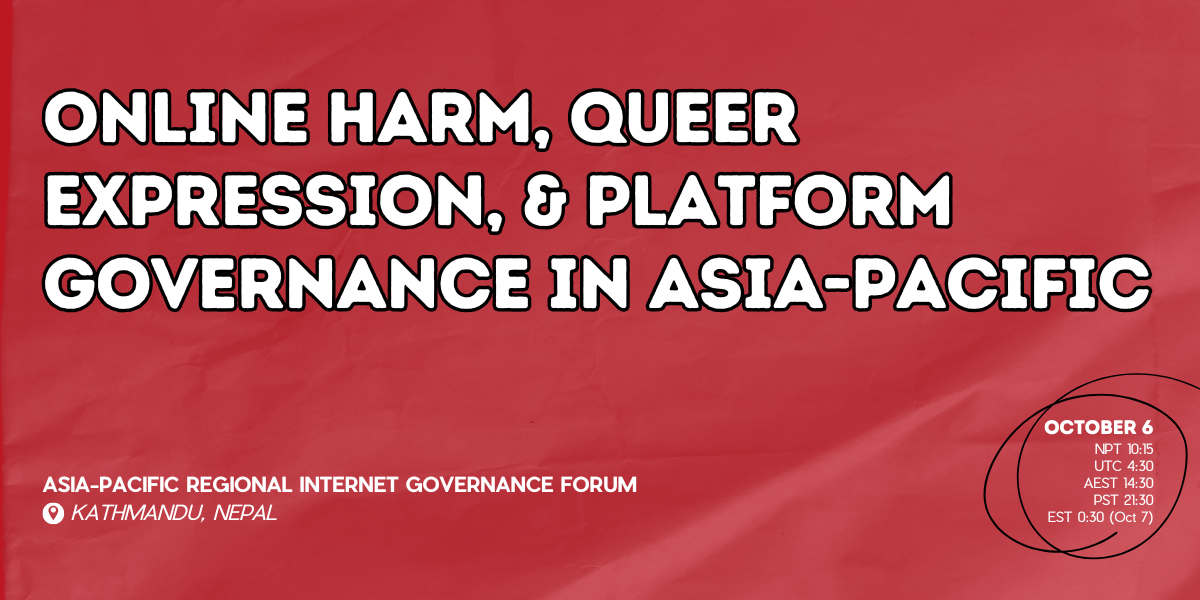
On 6 October, COSL will bring this question to the Asia Pacific Regional Internet Governance Forum (APrIGF) in Kathmandu, Nepal with our workshop, Drawing the Line: Online Harm, Queer Expression, and Platform Governance in Asia-Pacific. The session runs from 10:15–11:15 am Nepal time (04:30–05:30 UTC) and will be streamed live around the world.
|
|
|
The discussion will explore how online-safety laws and platform policies affect queer expression, artistic freedom, and cultural participation. Drawing on our Drawing the Line Principles and Watchlist, we’ll examine the consequences of conflating fictional and consensual expression with abuse, and discuss approaches that protect people while respecting their rights.
|
Here is the lineup of international digital rights advocates, legal scholars, and queer policy experts who will be leading the conversation at APrIGF Kathmandu:
|
- Dr. K S Park: Professor of Law at Korea University Law School and co-founder/director of digital rights organization Open Net Korea. Provides extensive expertise on internet law and digital rights advocacy.
- Jeremy Malcolm: Lawyer and Chair of the Center for Online Safety and Liberty (COSL). Specializes in harm reduction and the unintended consequences of overbroad safety legislation.
- Mish Pony: Representative of Scarlett Alliance and Flat Out. Focuses on how digital regulation, censorship, and content moderation directly impact sex workers and marginalized communities.
- Shambhawi Paudel: Research Associate at ILGA Asia. Explores the intersection of platform governance and LGBTQ+ rights, focusing on the regional impact of "online harm" frameworks on queer expression.
For advocates, researchers, policymakers, and anyone concerned about the future of online expression, this is an opportunity to help shape a more proportionate, evidence-informed approach to online safety. We welcome you to join us by registering for APrIGF at the link below.
|
|
|
|
|
|
|

|
|

|
The Latest from Our Blog
|
|
|
Moral Panic to Permanent Law: The Pattern of Fear & Censorship in Media
|
|
|
|
Every moral panic leaves a fossil record. When a society is confronted with a new medium it does not yet understand, the reaction rarely remains confined to outraged newspaper editorials or worried PTA meetings. The fear calcifies, becoming legislation, industry regulation, and algorithmic censorship. Today, as lawmakers rush to draft sweeping bills aimed at curbing the influence of social media, …
|
|
|
|
|
|
|
|
Pornography, Harm, and the Limits of the Law
|
|
|
|
Mick Moran, chief executive of the Irish Internet Hotline and a board member of INHOPE, the international association of internet reporting hotlines, argued recently in the Irish Examiner that "'ordinary' porn is now a gateway to child sex abuse material". Recommendation systems, he writes, feed an appetite for novelty and taboo until some viewers cross from adult pornography into recordings of children being …
|
|
|
|
|
|
|
|
What Wattpad's New Rules and the Rush to AO3 Truly Reveal
|
|
|
|
When Wattpad quietly rewrote its content guidelines last month, its writers didn't wait around for the hammer to fall. Overnight, they began packing up their archives (years of stories, millions of words) and migrating them to Archive of Our Own (AO3). Wattpad had just banned stories "created primarily for sexual arousal." From the outside, it’s easy to dismiss this as …
|
|
|
|
|
|
|
|
|
|
Experts Disagree on Taboo Fiction Rules
|
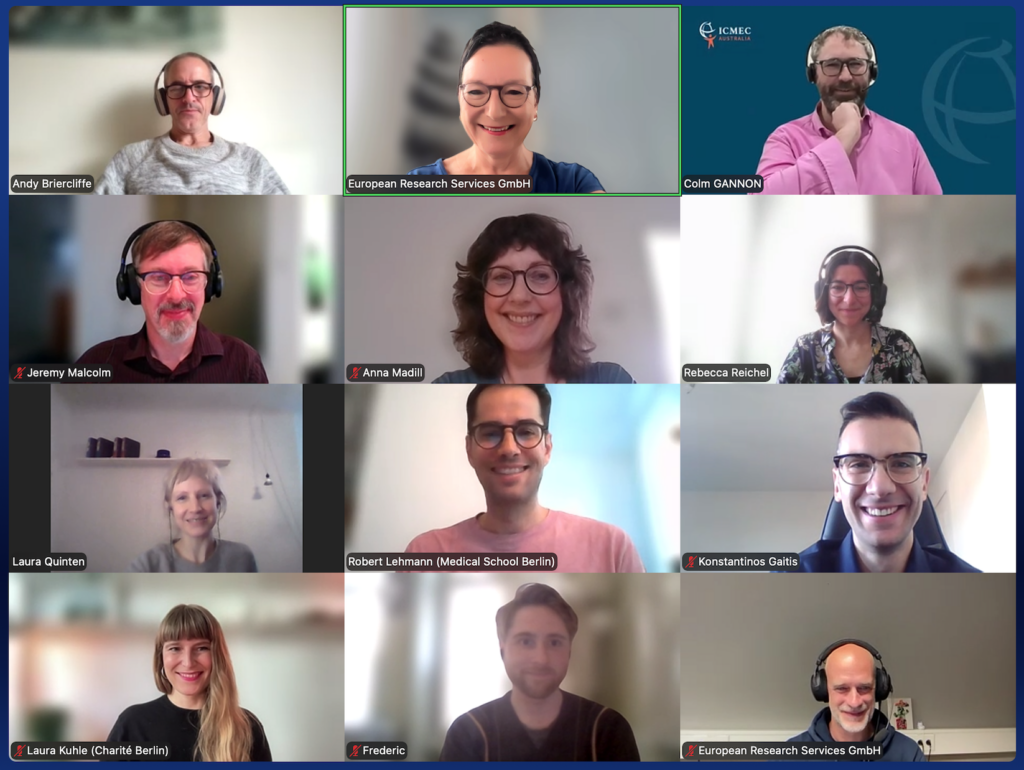
On September 28, COSL was represented at an expert discussion hosted by the Medical School Berlin (MSB) on the circumstances – if any – in which purely text-based stories should be treated as child sexual abuse material (CSAM). Our argument was that it is never appropriate for fictional stories to be included within that category, because doing so diverts focus away from crimes that have real victims, and harms marginalised communities whose expression is the first to be targeted by overbroad morality-based laws.
|
|
|
|
|
This was by no means a universally held view among the panelists, pictured above. Taking roughly a polar opposite view from COSL on the legal basis for the criminalization of CSAM was the representative from ICMEC Australia, Colm Gannon, who identified the basis of such laws not in the victimhood of those directly harmed by such material, but rather in the state's power to uphold the “social and moral” order of society, by criminalizing anything viewed as "tending to promote or support child sexual abuse". Stories can fall into this category because they are not just words on a page, he argued, but evidence of intent.
|
Professor Anna Madill from the University of Leeds complicated that picture somewhat by pointing out how for at least some subgenres of literature, including BL (Boys Love) fiction, both the creators and consumers of the material are predominantly young women, who are an extremely low risk group for sexual offending. Forcing such works into the category of CSAM or child pornography can see creators who are themselves minors being wrongly criminalized, she argued.
|
Further complicating the argument that stories indicate the real-world intentions of their authors or readers, psychotherapist Dr Laura Kuhle gave insights into the use of fictional stories among her clinical patients. As she explained, research does not support the notion that fictional sexual materials, or practices such as ageplay, are generally either harmful (promoting abuse) or helpful (protective against abuse) by nature. There is a lot of individual variation in how and why these materials are used, and the psychological effects that they have.
|
Gannon didn't completely rule out the notion that some stories depicting underage sexuality could be legitimate – he referenced Ted Dawe's novel Into the River, which was briefly banned in New Zealand over its depiction of sexual ideation among 15 year olds. But he placed responsibility for weighing their legitimacy firmly on law enforcement agencies and courts, suggesting that those who are targeted by authorities over works that they believe are legitimate could have their day in court to defend themselves.
|
COSL's Jeremy Malcolm argued that this was not an adequate remedy. The experience of author Lauren Mastrosa, convicted in Australia over publication of an erotic novel that depicted sexual ageplay, is a case in point – her name and reputation have already been irreparably sullied, even while her case remains under appeal.
|
Even when cases don’t go to court, the UK’s recent crackdown against “incest” themed pornography has seen queer creators self-censoring their work out of caution. There can be little doubt why they do this, considering the case of an archivist who received an incredible 40 year sentence of imprisonment for hosting a commercial archive of fictional stories and drawings.
|
Lawyer Konstantinos Gaitis agreed that the regulation of fictional stories is an activity far removed from the protection of actual children, and pushed back somewhat against Gannon's argument that laws criminalizing such works could be justified as the democratically expressed will of the majority. Realistically, voters are not providing a mandate on such measures at the ballot box, where they are more concerned with economic issues.
|
However, Gaitis also pushed back against the notion that taboo fiction should be protected as art – a category that he would reserve for material that "elevated society". Malcolm disagreed with this definition, arguing that art can serve many purposes. Also countering Gannon's claim that "survivors don't want their story to be told", he raised the example of autobiographical fiction by survivors that has fallen under a legal cloud, such as Debbie Dreschler’s explicit graphic novel Daddy’s Little Girl.
|
However Gaitis and Malcolm were in agreement that criminal law is generally too blunt an instrument to reliably distinguish “acceptable” from “unacceptable” stories – a job that should instead go to content moderators, editors, archivists, and trust and safety professionals who curate publicly available material. Andrew Briercliffe, a trust and safety professional who closed the panel, also acknowledged the nuanced nature of the exercise.
|
|
The session closed with the organizers asking what we should call the stories that were the subject of the workshop. COSL had not been quiet about our view that the term tagging entire works as “child sex stories” wasn’t helpful; it effectively prejudged them socially unacceptable, and discounted their diversity. Most panelists agreed that there wasn't a single term on which it was likely that agreement could be reached.
|
The panelists did, however, concur that the organizers from MSB's WRITE project were to be commended for hosting a diverse enough panel that we were able to respectfully disagree with each other – a rarity in the child protection sector which is too often characterised by groupthink. An article from the WRITE project summarizing the panel's discussion is forthcoming for publication in the next few months.
|
|
|
|
|
|
Elephant in the Lobby:
On Fiction, Victims, and Offences
With the recent panel on text-based fictional depictions and sexual content organized by the Medical School Berlin, I thought that now would be an appropriate time to discuss the nature of broadened definitions of CSAM, who ultimately benefits from the criminalization of fictional material, and why it isn’t enough to argue that fictional material prevents recidivism and re-offense.
|
The push to redefine CSAM to include fictional materials such as drawings, comics, writing, fanworks, etc., is troubling for various reasons, not the least of which is that it bottlenecks the efforts of law enforcement agencies and child protective agencies to actively stop trafficking, exploitation, abuse, assault and grooming. Every report made because of an erotic manga or a dark romance book is money wasted and spent investigating a case that involves no known victims. This should be the argument made against the criminalization of fictive works, mainstream or otherwise. Proponents of the expanded definition claim that these materials only encourage individuals who are likely to offend, that it normalizes harms against children, women, men, minorities, and even animals. My counterargument is that if normalization of harms comes to pass or has come to pass in the past, it did not happen because of objectionable media only, but because societal norms and laws permitted these harms to exist in spite of protests by the affected. Forced and arranged marriages are still cultural norms that persist in some parts of the world, and the harms that exist because of them are encouraged or ignored simply to uphold the custom. Marriages of minors to much, much older people—minors, who legally cannot give consent—are still legal in some parts of the United States, and these marriages cause considerable psychological, physical and emotional harm to girls and boys coerced into them by their parents.
|
Who benefits from these expansions are criminal organizations themselves, who would most likely find it helpful that investigations into their activities are hampered by antis who contact NCMEC because they saw fictional erotica that depicted taboo material (taboo, not illegal or unlawful). Andrew Tate and his brother were recently arrested in Miami, and now are facing extradition for their crimes of exploitation, abuse, trafficking and more. I cannot say for certain if this would have happened more quickly if it had not been for laws criminalizing fictional depictions of subject matters that are equated to CSAM or abuse. However, this event underscores why criminalization of fictional material is largely egregious. The arrest happened because there were real victims, people who could give testimonies to officers and organizations investigating the Tate brothers’ activities. They can present evidence and be physically present to make a case. Fictional characters cannot because they are not real entities capable of doing any of these things. More than that, criminalizing fictional material only trivializes the very real struggles and injustices that victims of trafficking, abuse and assault face each day that they have to live with what was done to them. Victim-based investigations and real, measurable harm ought to be the standard by which we protect children, not by how offensive the material is.
|
It’s not enough to say that these materials prevent offense, or to say that they reduce recidivism, because there are more factors that go into what makes someone likely to offend or re-offend than simply having access to material. The problem in this argument lies in the fact that some offenders and abusers don’t exhibit an interest in fictional erotica or in fictional material. Some sexual offenses don’t occur simply because of sexual desire or because of compulsion. In some cases, it’s out of a desire to exert control over the victim, who is seen as helpless and lesser by the abuser. In other cases, it’s out of desire to punish the victim, or to ‘teach them their place’ in spite of the victim’s protests. The autonomy of the victim is of no consequence to the re-offender, or to the abuser, or the exploiter and trafficker. Boundaries do not exist for them where their authority is concerned. Sexual abuse, assault and CSAM don’t only happen because of compulsions, but because the perceived profit and benefit of committing the crime outweighs any ethical and moral considerations.
|
To throw away these complexities before they’re considered, in favor of the international criminalization of fictional material, is not a good look for groups that claim to protect victims and children, when we have real, living, breathing victims and children who can speak about their experiences at the hands of cruel abusers. To criminalize fiction would be akin to giving agency and rights to fictional characters—entities that do not exist, cannot legally make cases in court for themselves, cannot present evidence, and cannot identify abusers.
|
|
|
|
|
|
|
|
|
|
Help shape the conversation: become COSL’s next Blog Editor
Behind every debate about online safety, privacy or freedom of expression are people whose lives are affected by the decisions being made. Making those connections clear—and giving readers the knowledge to question, engage and act—is an important part of COSL’s work. We’re looking for a volunteer Blog Editor to help us tell those stories.
|
This is an opportunity to shape the direction of our blog and build COSL’s public voice. You’ll follow emerging issues, spot stories worth exploring and bring together contributors who can offer informed, engaging perspectives. You might commission an article from a researcher, interview someone working on a COSL project, or write an explainer that helps readers understand a complicated policy debate. Working with advocates, lawyers, technologists and activists around the world, you’ll help turn their knowledge into accessible, carefully checked articles.
|
We’re looking for someone who enjoys both ideas and the work of bringing them to publication: developing a calendar, building relationships with writers, sharpening an argument and making sure the facts stand up. You’ll also work with our communications volunteers to help articles reach a wider audience. Throughout, you’ll help express the conviction at the heart of COSL’s mission: protecting people online should go hand in hand with protecting their fundamental freedoms.
|
You may have a background in writing, editing, journalism, research or advocacy. What matters most is your enthusiasm for these issues, sound editorial judgment and demonstrated ability to communicate clearly. Formal qualifications matter less than what you can bring to the role.
|
This position is fully remote and open to volunteers anywhere in the world, with a commitment of approximately 5 hours a week. Most work can happen asynchronously, with flexible scheduling and occasional meetings. Along the way, you’ll build a portfolio, develop editorial experience and make connections across the international digital-rights community.
|
|
If you’ve ever read a story about the Internet and thought, “There’s an important perspective missing here,” we’d love to hear from you. Please also share this opportunity with anyone else whom you think would make a great fit.
|
|
|
|
|
|
|
|
|
|
Support our work!
Pledging your monthly support for our work is the best way that you can support us, because it gives us the stability to plan ahead. You can pledge your support at three levels.
|
|
|
|
|
|
|
|
|
|
Keep In Touch With Us
|
 
|
|
|
|
|
|
|
|