
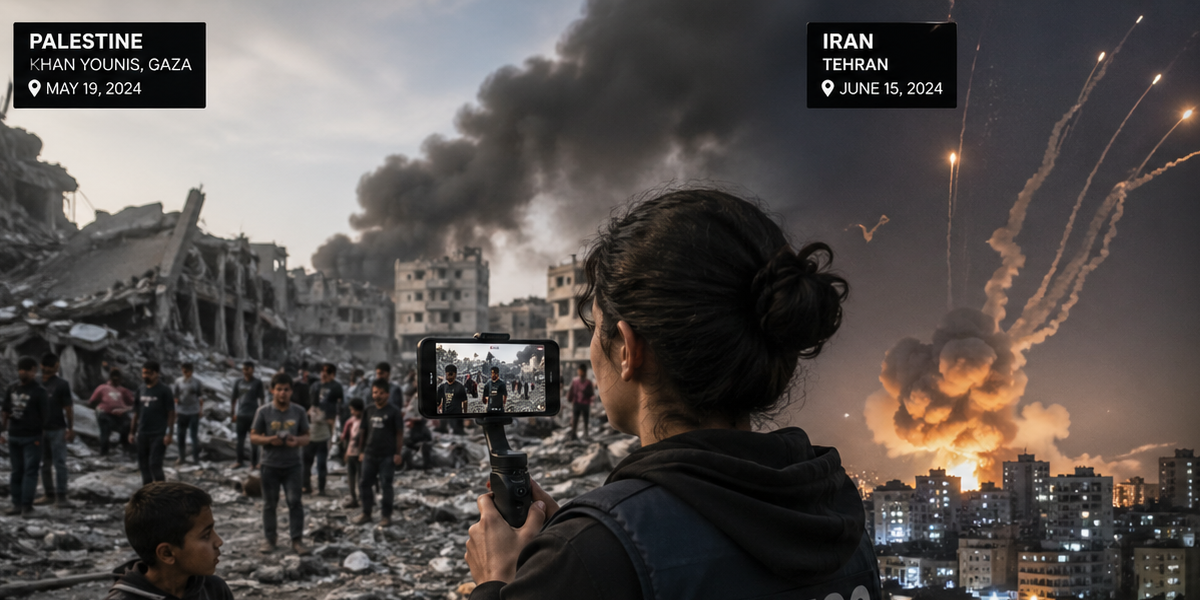
The conflicts that have gone on in the Middle East have always been a hot topic of discussion. People have been killed by their own governments or foreign entities, bombs have leveled civilian infrastructure, and aid has been blocked to prevent it from reaching desperate civilians. Particularly within the past few years and more recently, Palestine and Iran come to mind in the midst of destruction, apartheid, and regime change being thrust upon them. A few decades ago, the only way the world population could get information was through major media outlets, often with underlying bias on who should be sided with within the conflict. The past few years, however, have shown journalism taking a new approach to covering these events, with civilians in their countries logging what is going on first-hand to be posted on social media.
The Palestinian-Israeli and Iranian-American conflicts have been well-broadcasted over the past few years, and a huge part of the coverage is from civilians using their phones to record what is happening. There are, however, some downsides to this new-age of journalism on social media that worsen, hurt, and devalue what is going on where people on the outside have to second guess the information they are presented with. The conflicts in Palestine and Iran are ever-evolving and being constantly covered by notable civilians, and with it, it is important to discuss how social media is being used as a tool to document conflicts as they have never been before. Overall, social media has been a powerful medium in influencing public understanding of war, occupation, and genocide across Palestine and Iran in terms of who reports, what the issues are, how the states respond, and how it influences public perception.
In addition, Brandy Brightman, Secretary of the Center for Online Safety and Liberty, has been following the news coming out of the Middle East and discusses her viewpoints on what is happening.
How Social Media Changes Who Reports
Before diving into the true complexities of how social media is used to chronicle conflicts, it is important to discuss the purpose of each platform and how it is used by civilians and journalists across the Middle East. Social media has evolved over the years for every user to turn to a different platform to ingest a different kind of media, and individuals in the Middle East use this to their advantage to categorize their information into the appropriate platform.
Beginning on TikTok and Instagram, they both have a fairly similar content production goal of short form videos and one to multiple pictures being shared on the same post. It is deemed the champion of telling stories from a visual standpoint, making quick, organic, easy digestible posts that show what is happening in these states. They are highly popularized platforms for civilian and photojournalist to share their work and garner support for sharing emotional stories from civilians in their area.
X, formerly known as Twitter, is different in publishing information due to it’s short messaging form of posting. It is best used for quickly creating news updates, as well as sharing short clips of events happening. X has been at the crux of political messaging from the time it first starting existing, especially with trending hashtags surrounding opinions on certain issues and the fast pace that tweets can be circulated.
YouTube has become a very prevalent platform to share long-form content on, and has dominated in this area over any other platform. It is the go-to place to find documentaries, video essays, and polished videos from independent journalists and organizations. Brightman shares that a Youtuber she recommends is friendlyjordies, who discusses world politics from an Australian point of view. Each of these platforms play a crucial role in sharing information and exposing evidence on a global scale for anyone to view.
The most prominent way social media platforms are being used in these conflicts is how civilians have taken it upon themselves to show the world what is happening to their people, homes, and lifestyle. For Palestinians, civilian journalists tend to cover bombings, life living in displacement camps, hungry citizens being targeted while getting aid, and the suffering of children. With Palestinian journalists being bombed and attacked by the Israel, citizens in Gaza have taken the reigns to put out news for the rest of the world to see.
One of the most popular journalists to cover the genocide, Bisan Owda or The Wizard Bisan, has been documenting what has been happening in the Gaza Strip ever since the start of its bombardment in late 2023. Her award-winning social media series “It’s Bisan from Gaza and I’m Still Alive” showcases day-to-day life living in Gaza, including covering bombings, updates on where she evacuates to, and even the moments of children having fun in the streets.
Another distinguished journalist from the Strip is Plestia Alaqad, who’s reporting has most recently covered life after the ceasefire. She stated how Gazans are displaced due to their homes being destroyed, how Israel is still murdering Palestinians through gunfire and shelling, the blockade is ongoing, and citizens are restrained and trapped in 40% of their land as Israel inhabits the remaining territories of the Strip. Despite the more recent enactment of the ceasefire, civilian coverage of Gaza remains important since people are still suffering.
In Iran, contact with the outside world is limited due to the Regime cutting off internet access. With the information we do get, we are told about civilian infrastructure being bombed, targets being placed on nuclear sites, and the killing of Regime leaders. One of the most prominent stories covered by civilians recording the incident was the bombing of the school in Southern Iran, killing predominantly children. The Instagram news story from the Financial Times uses many angles of the bombing recorded by civilians, showing why raw footage from the victims of this massacre provide the most unfiltered reporting. Again to reiterate, obtaining information for Iran is difficult due to the Internet blackout enacted by the Regime, but Iranians are able to persevere to publish their information for the rest of the world to witness.
Why That Creates Credibility Problems
The Palestinian conflict is no stranger to misinformation, since it has been ongoing for several years since late 2023. According to PBS, images and videos on social media have been modified and taken out of context, with a handful of users minimize the death toll and claiming crisis actors were put in place. Todd Helmus, a senior behavioral scientist specializing in disinformation and violent extremism at Rand Corp., dicusses how “everybody wants to know the truth, but there’s limited information that’s out there, and that creates an opportunity for others to exploit this,… People feel strongly about this, and whenever people feel strongly about something, they are very eager to find information that validates their views,… So, it’s not surprising that in the immediate aftermath, you would see a lot of false information, a lot of out-of-context information.” It is difficult for any side of a conflict to express their truth when misinformation is about, and it is especially hard for Palestinian journalists when their information is being misconstrued.
In the case of Iran, misinformation was already spreading when the bomb struck Shajareh Tayyebeh school and killed 168 civilians. This led to engagement farming where clips of flight simulators circulated online and was regarded as real operations footage, and old videos of missile attacks and out-of-context pictures of battleships were sold to viewers as Iran’s immense power. An investigation from Wired showed that misinformation heavily plagued X with hundreds of posts with deceptive photos and videos, including AI-generated content.
In addition, fake claims were provided to enlarge the scale of the attacks. One post in particular that accumulated 4 million views declared ballistic missiles were flying over Dubai, but in reality showed an Iranian attack on Tel Aviv in October of 2024. A different post that amassed 375,000 views showed a fake before-and-after image of assassinated Iranian Ali Hosseini Khamenei’s shelled compound. Misinformation coming out of Iran is heavily altering how the world view the country, especially with journalists having a difficult time getting information out due to the Internet blackout.
Brightman was asked about her opinion on credibility issues playing a role in reporting, sharing that “it is potentially misinformation that pro-Palestine, anti-Trump people are supporting the Iranian regime, as well as Iranians against the Iranian regime supporting Trump and Israel. They are all bad!”.
How State Platforms Respond
The effect censorship has had on Palestinians is brutal, as it has plagued social media since the Hamas attack on October 7, 2023. Human Rights Watch reported over 1,050 takedowns and other forms of suppression across Meta platforms like Instagram and Facebook that was posted by Palestinians and sympathizers, including information about human rights abuses. It is also mentioned that 1,049 out of the 1,050 contained peaceful content that supported Palestinians that was suppressed or fully censored. Even after the analysis was conducted, many more cases were reported exceeding the initial total. Palestinian censorship is an issue that was at its most prevalent in the beginning, but continues to impede social media platforms and silence those bringing up their voice.
For the censorship taking place in Iran, the Regime has censored all content on a massive and unavoidable scale. Large civil protests at the beginning of the year caused the Iranian regime to create a full-scale Internet blackout. According to Ali Vaez, director of the Iran project at the International Crisis Group, it is a new enactment for the country, but the bombings that the U.S. and Israel conducted on nuclear sites were “widely reported by the citizenry on social media networks”. Vaez states the second week of the 12 day war that restrictions were starting to be activated, and they have continued int he current war. These restrictions, say Vaez, are incredibly serious and strict. Due to this, social media usage within the country is severely limited, and makes contact with the outside world incredibly difficult.
What This Means for Public Perception and Activism
The Palestinians have been fiercely headstrong in demanding the international community try to aid them in anyway they can. As reported heavily during the height of the Palestinian genocide, aid trucks were intercepted by Israeli forces and citizens were forced to stay in the Gaza strip, making it an open air prison. Because of this civilians began using what little they had to make videos online urging people to donate to gofundmes or contributing other ways to help. Palestinians were able to learn marketing tactics in order to have a better chance of getting support from a good samaritan. It was fairly effective in its goal, but was a sad reality than the common citizen was able to do more than some world governments.
In addition, Bisan Owda has been a powerful force being the voice of Palestinians. With her reporting, she also makes announcements for the rest of the world to protest what is happening to her people. Her most recent plea for a global protest titled “Rise for Freedom” is scheduled for April 17. She stated in her Instagram post “For decades they’ve tried to convince us that our movement and attempts at change are futile. This is part of the engineering of defeat, exploiting our emotional and impulsive nature against us, even though this is our most important motivation and driving force. Therefore, we must be convinced that we can rise up, and this is our chance. +9,400 Palestinian hostages await us on their journey towards freedom”. The citizens of the Gaza strip are admiringly relentless in their quest to provide for their people and stand up for them, as their fight still continues after the ceasefire.
As for Iran, civilians around the world have been quick to defend the people of Iran from the start of the incredibly oppressive actions taken by the regime to the war the U.S. has provoked. One instance of a statement telling Iranians to stand up against their regime comes from Reza Pahlavi, who is a leader of the Iranian democratic opposition. His article from The Times reviews how Iranians knew the price they were paying when they marched into the streets demanding freedom, because they paid it with their lives. The people of Iran have the power, he claims, and calls for Iran’s security forces to “stand with your people or stand against them”. He concludes by stating “this revolution began with the people of Iran. It will end with them as well. And when it does, it will mark not only the end of tyranny but the beginning of a new era, for Iran and for the world”.
On the opposite side of the globe regarding the war, students at UC Berkeley have staged a protest against Trump and his assault on Iran. Activist group By Any Means Necessary organized a protest to signal military leaders to disobey Trump’s unlawful orders and cease military actions in the Middle East. Their fliers wrote “Defeat Trump and Netanyahu’s Fascist/Zionist War Drive” and held signs encouraging participants to “Defend Iran”. The documentation of protests, killings, and bombings of Iran have brought powerful political leaders, both from Iran and American student bodies, to the forefront of defending the Iranian people.
Because of these conflicts, citizens across the world are being exposed to the true horrors going on in these countries by Palestinians and Iranians, thanks to social media. People who may have been previously sympathetic towards one side have completely turned around shown support for the other side after being shown evidence that changes their viewpoint. Not too long ago, many Western populations did not fully understand what has been happening in these countries leading to the more explosive recent conflicts. Currently, a huge change has occurred with more Americans sympathizing with Palestinians over Israelis in a Gallup Poll, as well as most Americans moderately or strongly opposing military action in Iran from Pew Research Center.
Across the world, thousands of protesters show up to denounce the actions genocidal, tyrannical, and fascist regimes making decisions that do not favor the innocents caught in war. Social media brings a free education of real, raw information that comes straight from the source, and sometimes not tied to a news organization that bends the narrative. The intellectualism of the Western World is blossoming because people are taking advantage of these tools and acting on their own accord to make change. Without these platforms, it might have been a different story to how the world would have viewed these conflicts.
Conclusion
While the conflicts in Palestine and Iran are ongoing and show no intentions of dying down, the public perception of what has been happening across the globe has shifted tremendously thanks to social media. More and more people are showing up to support those across the world that are facing hardships in their respective countries, and trying to make changes to better their lives. There are inevitably downsides to using social media to report on issues like this, but the world is able to see the true struggles of Palestine and Iran due to the brave journalists and media professionals who report information to the public.
In terms of discussing social media being a good path forward in educating people on these conflicts despite the disinformation being published, Brightman stated “It could be, but in its current form, probably not. The social media algorithm does not reward nuance, these issues require nuanced understanding, not polarized. It could theoretically work but it’s not all bad. There is information getting out through social media that can only get out through social media”. Even due to the fact that a plethora of information is available from these platforms, the wars continue with no sign of resolve and outsiders witnessing the destruction fight each other on what is the right side. The net effect this has created is having raw, organic news readily obtainable to anyone in the world, at the cost of misinformation, censorship, and fuel for further tension between different viewpoints. The platforms we engage in everyday have equalized conflict reporting, but diminish credence. Even though social media reporting comes with its risks, it can be sometimes be reliable compared to a biased news that comes out of major networks. Social media and the conflicts have a long way to go in order for their issues to be resolved, but it should be heavily articulated that a global uprising of support for Palestine and Iran would probably not be possible with the influence of the platforms we use everyday.